View Larger Map

Picture all the Bronte eee's in this next write-up with 'umlauts' over them, 'k?
Lena and I are just back from three days in Yorkshire and what's known (really) as "Bronte Country." In a nutshell, the trip was literary, historic, green, pastoral, cobblestone-y, and fun. I just uploaded around 150 pictures to Flickr, just a click away on the right-hand side of your screen. There's no way to capture the beauty and the sights of the weekend in the few photos I'll post in my (albeit longer than normal) post below, so check out the larger group of photos on Flickr with your morning cup of coffee (or tea, as the case may be).

On Friday, we traveled by train for about five hours: first, from Oxford to Leeds (with a couple of train-changes in between), and then from Leeds to the small town of Keighley ("Keith-ly"). From there, you can bus down to Haworth, where the Brontes lived, or you can take a restored steam locomotive! (Guess what we did? Here's Lena at the beautifully-maintained steam train depot.)

Here I am on the steam train, which was literally steamy (and musty) inside, but a great experience through three miles of small, former textile towns (Haworth itself is a former mill town, known for the green, orange, and brown "Bronte Tweed" that evokes the colors of the surrounding countryside).

This first day in Haworth was wet like another author-seeking day Kaijsa and I had (which I forgot to mention in my previous list of literary tourism) to Isak Dinesen's house in the rainy, rainy, rainy Danish countryside (probably The Rainiest Day of My Life next to my own college graduation). Haworth is a town of about 6,000 that trades pretty much entirely on 1) The Brontes and 2) hiking around the area to see things associated with The Brontes.

Here's our youth hostel, which will spoil me forever for youth hostels. For 23 pounds each/day, we each had a comfortable bunk and a full English breakfast (ham, scrambled eggs, croissants, canned fruit, yogurt, cereal, coffee, tea, and baked beans... okay, I didn't eat the baked beans).

This is the view of Haworth and the Yorkshire countryside from our room in the hostel. The hostel itself was a hilly mile walk from the core of Haworth and the Bronte sites.

After settling in, Lena and I made the drippy walk to Haworth's steep, cobblestoned Main Street where the official Bronte structures are located. Lena's pictured on Main Street with its many flowers.

Now, let's review: At one time, in the 1820's, there were six Bronte children (five girls and a boy) + Mr. and Mrs. Bronte. Then, Mrs. Bronte dies. Not long afterward, two of the girls die (note: the infant mortality in Haworth was 50% at the time). That leaves Charlotte (Jane Eyre, Villette, Shirley), Emily (Wuthering Heights), and Anne (The Tenant of Wildfell Hall). Their only brother, Branwell, was a painter. Basically, they're all homeschooled and brilliant. Read more about their literary and artistic productivity at http://en.wikipedia.org/wiki/Bront%C3%AB. Then, Branwell dies of a combination of TB, alcoholism, and laudinum addiction. Emily catches a cold at her brother's funeral and refuses medical attention, dying on a couch that's still in the house (as is much of the family furniture). Anne also dies that year. That leaves Charlotte, who marries, and Mr. Bronte, her father. Charlotte dies nine months into her marriage, pregnant. Mr. Bronte lives into old age, blind and depressed, with his son-in-law, Charlotte's husband. Happy story, no? The pub pictured above, The Black Bull, was a favorite of Branwell's.

Both of our guidebooks recommended dinner at Weavers (pictured above), described thus: "Smart and stylish, with simply the best food in town and a menu featuring local specialities." For example, Lena started out with carrot-coriander soup, and I started out with trout pate. Then, Lena had shepherd's pie, and I had risotto with local peas and asparagus. Awe-some. When we got back to the hostel, Ed was able to call, and he and I gorged ourselves on a $55 phone call that was worth every penny. He sounded great!

The next day, we returned (in the sun), to visit Main Street (above) and the Bronte parsonage.

Here's the Bronte home/parsonage. Much is made of the fact that the girls lived next to, looked out at, were "inspired" by, and possibly contracted poor health from, the graveyard just in front of the door pictured above.

This is from the front of the house, looking out at the graveyard (much more "tree'd" than it was in the Brontes day), and at the church under which the Brontes are buried. Longtime servant, Tabby, is buried in this graveyard.

Lena and I entered the church under which the Brontes are buried, marked by this engraved pillar (sorry it's so dark and hard to read).

The Black Bull, Branwell's haunt, is immediately next to the church, and the apothecary where he got his opium is next door. When I read Elizabeth Gaskell's 1857 "The Life of Charlotte Bronte" two summers ago for my Brontes class in Juneau, I pictured these sites at a greater distance from one another. Instead, the home/parsonage is next door to the cemetary, which is right behind the church, which is smack next door to the pub, which is across the street from the apothecary.

We were lucky to catch this bit of local color: An afternoon wedding party arriving for a ceremony in the church where the Brontes are buried.

Here's one of the wedding guests.

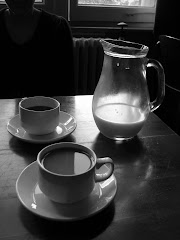
Next, Lena and I had tea and hot scones on a balcony downtown overlooking the surrounding hills. Pictured is a cup of Earl Grey with a currant scone, topped with raspberry jam, butter, and "clotted cream."

Lena and I caught a bus to the town of Hebden Bridge (1/2 hour south), a bit funkier and artsier than Haworth. Interestingly, Sylvia Plath is buried in an even smaller town above Hebden Bridge, as she was living in the area with Ted Hughes at the time of her death. The drive, through green valleys, waving grasses, and fields of sheep, was jaw-droppingly pretty.

We took a break in Hebden Bridge to eat a Yorkshire Pastry (which the shopkeeper pronounced "pass-ty"), filled with a yummy, savory, smash-up of meat + gravy + potatoes. Later in the evening, we walked from the hostel back into Haworth for Indian food (mmm).

We lucked out, both weather-wise and schedule-wise, for our return trip. On a sunny day for traveling, Lena and I made an earlier train to Leeds, which put us on a direct train to Oxford (versus changing a few times) with plenty of seat choices the entire way. We bought some groceries for a train picnic at the Leeds train station, which has a Marks and Spencer "Simply Food" store (if Ikea and Metropolitan Market had a baby, it would be M & S "Simply Food"), and ate/read our way back to Oxford.

Shortly before we arrived back in Oxford, we passed on the train this field of lavender growing north of town.
I came home to a card from Ed (Ed, it's your July 4 Tenakee Springs card with the 1926 vintage map of Alaska on the front... thank you!), an excellent homecoming.
Have a great week, everyone!


![I [heart] The Cheese.](http://3.bp.blogspot.com/_E-u44oF-FAY/SIcMWlaD71I/AAAAAAAAAcs/ZmEhNxmOzus/S240/Punting,+King+Lear+035.jpg)






1 comment:
Yes, that day in Denmark was wet, wet, wet. But worth it.
Your post made me hungry! Beautiful pictures, Mel.
Post a Comment